$20/month vs. $2,000/month — getting inventors ready for the experts.
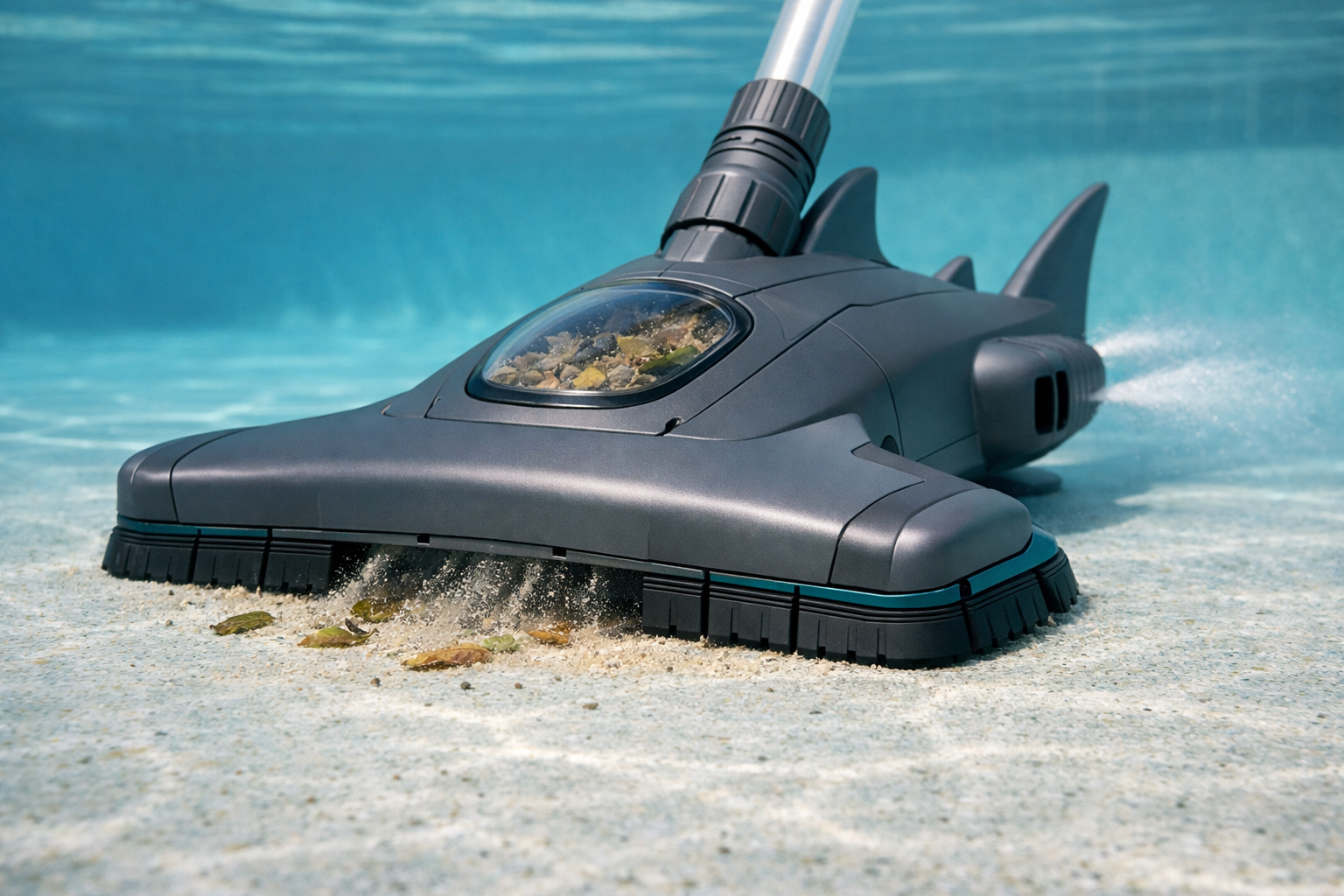
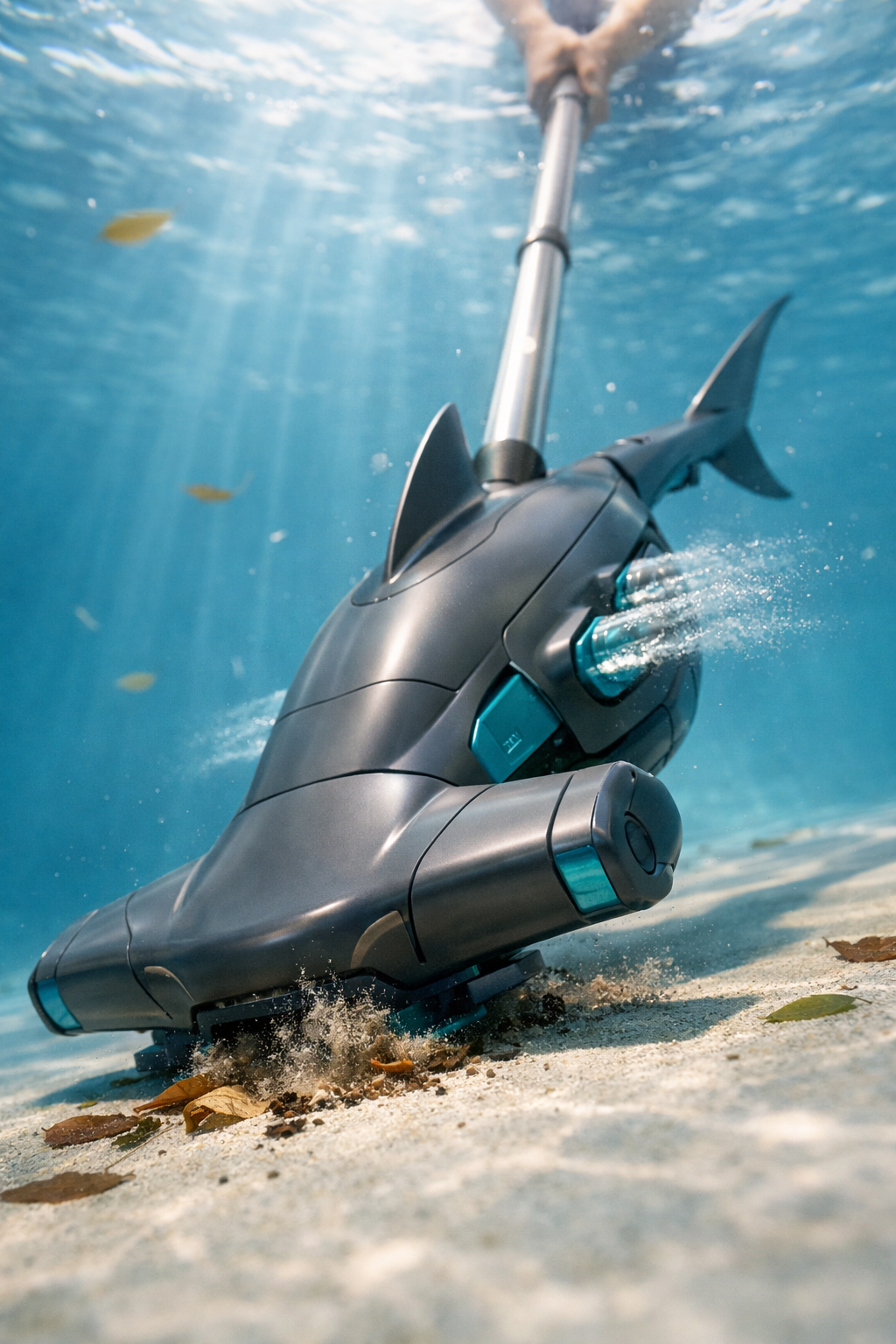
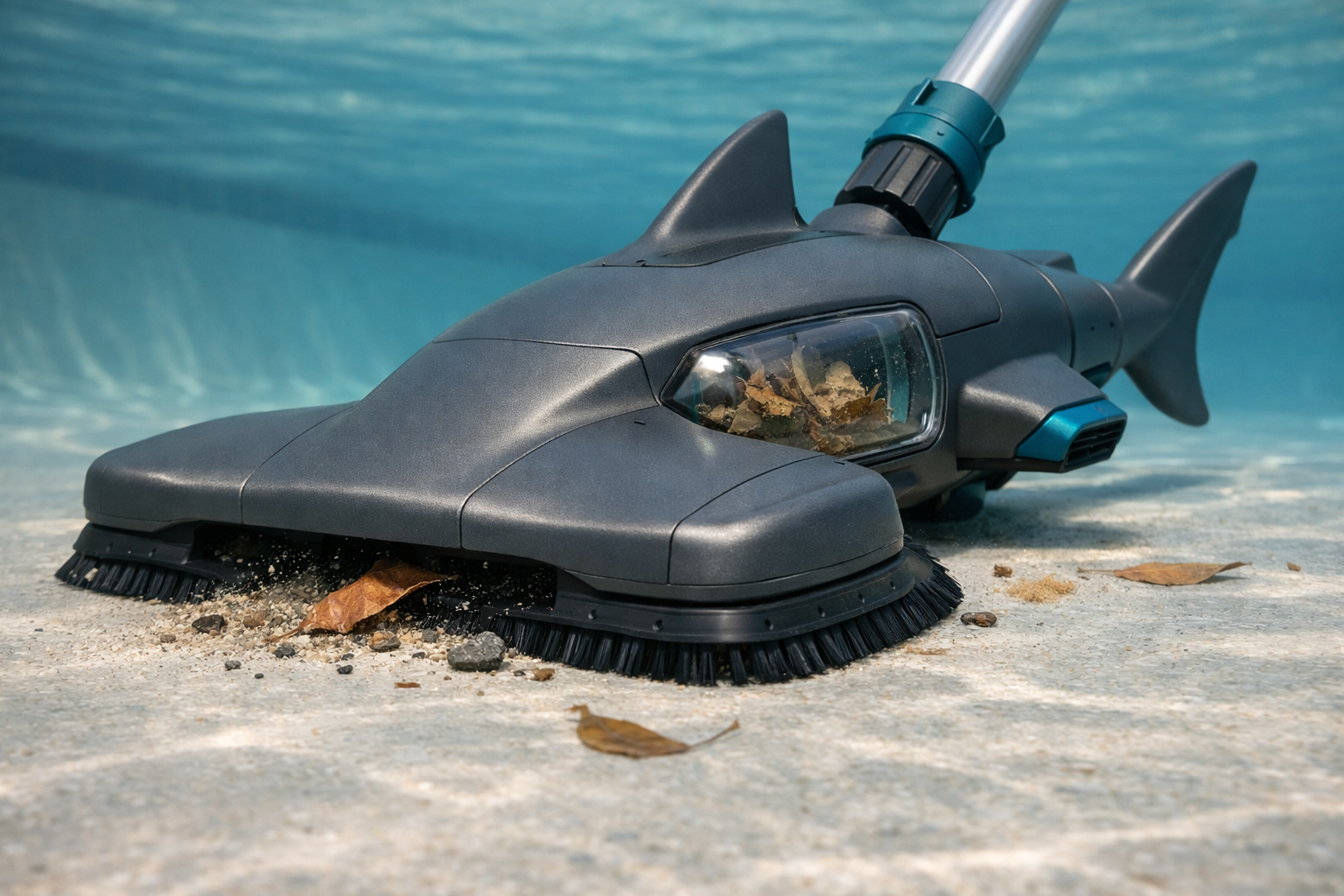
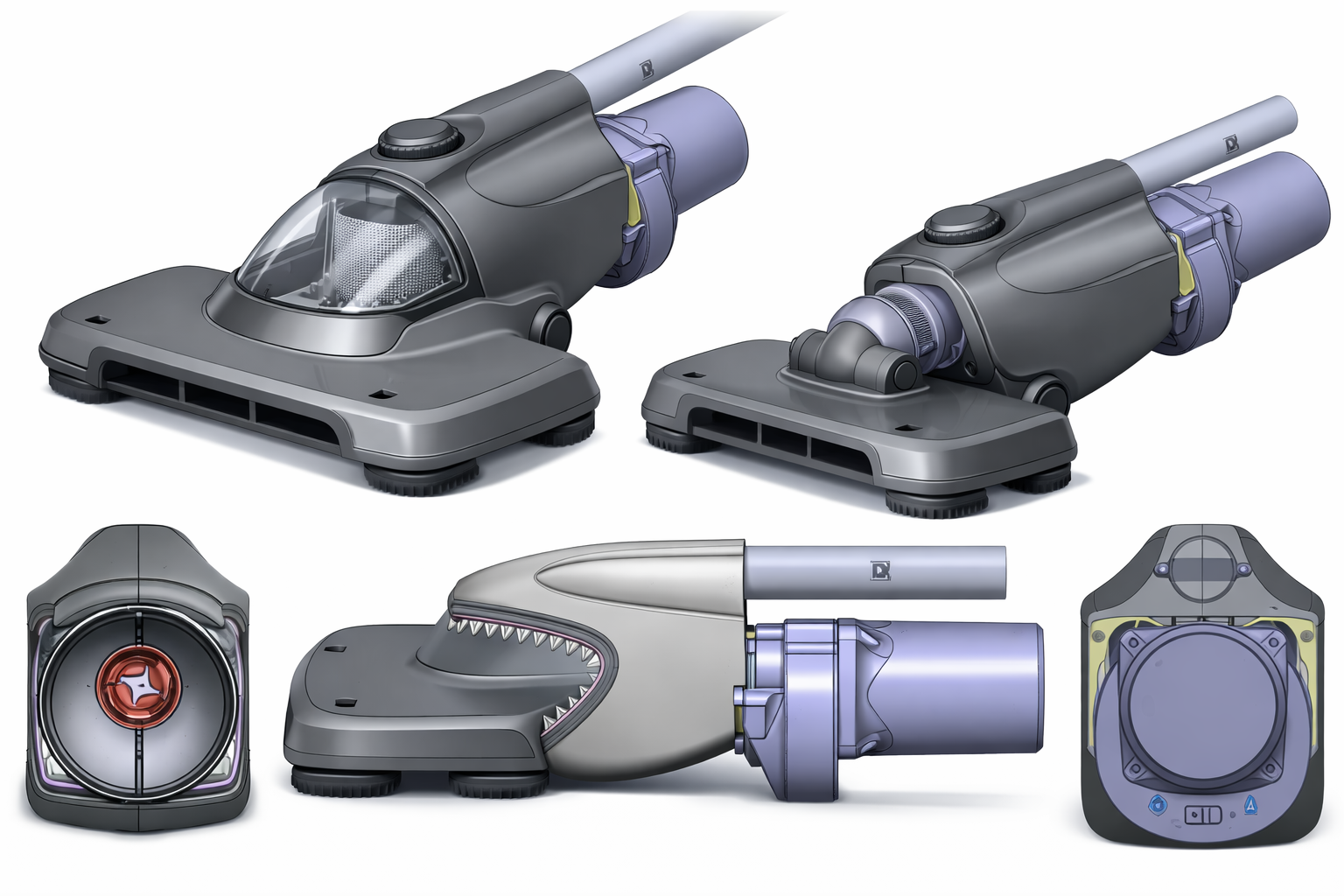
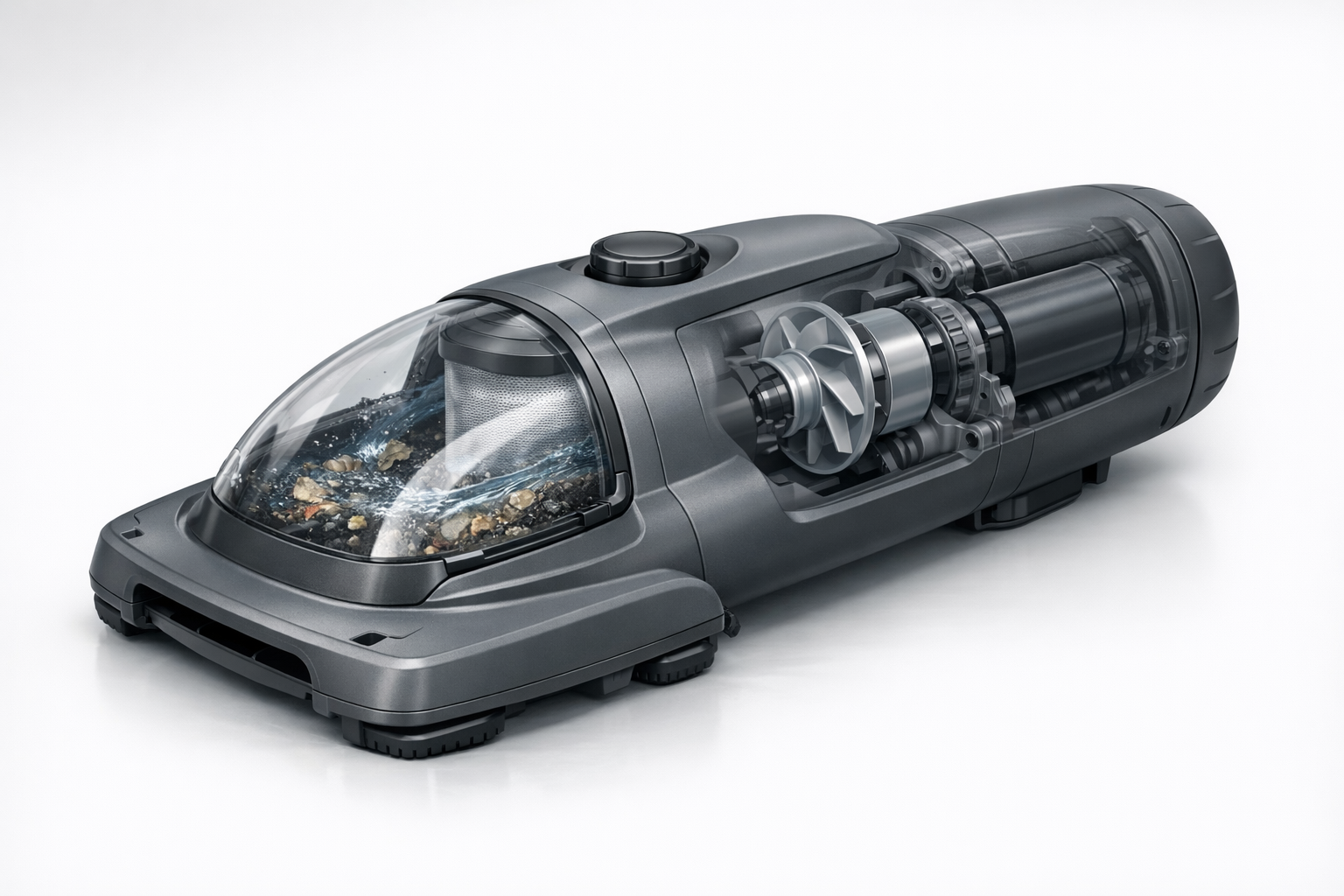
The idea: a battery-powered, manually-guided submersible pool vacuum with a hammerhead shark form factor. The hammer-shaped head doubles as the suction nozzle. The body houses a sealed battery, electric pump, and debris canister. A shark tail transitions into a standard pool pole interface.
The shark shape is not arbitrary — the hammerhead silhouette naturally implies a wide cleaning path (the head), a central debris volume (the body), and directional stability (the tail). The question was whether this could be engineered into something that actually works at residential pool scale.
The first question was simply: can AI generate something that looks like this product? The answer in 2024 was: sort of — but it required significant prompt engineering.
Early prompts produced toy-like, cartoonish results — shark teeth, decorative fins, fantasy proportions. The prompt had to be rebuilt from scratch with engineering vocabulary:
This is where the AI added real, measurable value. Rather than guessing which design choices might fail, the inventor used ChatGPT to perform a structured design audit — before spending a dollar on engineering time.
| Risk Area | What AI Identified | What Would Have Happened Without It |
|---|---|---|
| Suction Lock | Wide nozzle can fully seal to smooth vinyl/fiberglass, sticking to the floor | User returns product — "it gets stuck" |
| Debris Bridging | Wide intake is susceptible to leaf matting — forming a dam across the opening | Rapid clog, performance collapse in 2 minutes |
| Relief Channels | Channels in the rubber skirt can trap sand and hair, eliminating the relief effect | Suction lock worsens over time — not better |
| Context Window Seals | Multiple user-opened seals (canister, window, battery) are the primary field leak source | Water intrusion, battery damage, warranty claims |
| Pole Interface Loads | Users twist and pry — small tabs in plastic will crack under real torsion loads | Joint failure within 3–6 months of use |
| Buoyancy / Stability | If CG is above CB, the head can roll during direction changes, breaking the floor seal | Inconsistent cleaning, user force compensation |
| Clear Window Cracking | Polycarbonate stress cracks in chlorinated water, especially near corners under snap stress | Cosmetic failure → returns |
| Injection Molding Undercuts | Hammerhead protrusions may require side-action tooling, increasing cost 30–50% | Tooling surprise late in development |
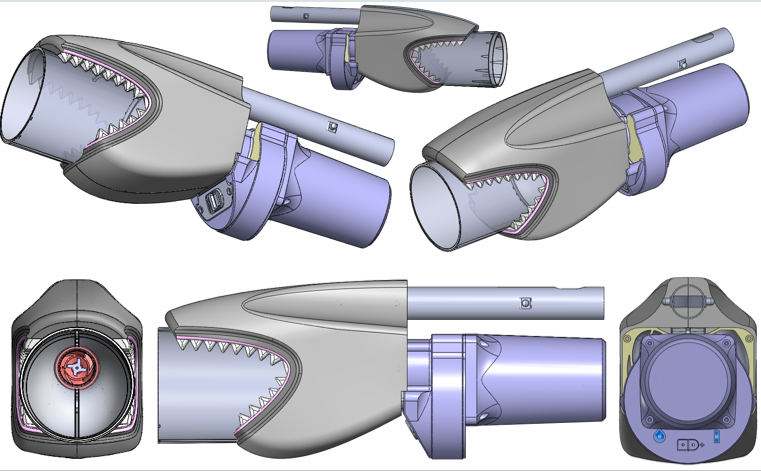
This phase demonstrates both the capability and the limit of AI. The inventor needed to understand the nozzle fluid dynamics — specifically the inlet geometry that would maximize debris pickup without clogging.
What AI actually delivered:
The inventor was working in SolidWorks. AI served as a patient, always-available CAD tutor — explaining equation-driven sketch mechanics, debugging disconnected curves, validating geometry against the parametric equations, and guiding the revolve operation step by step.
The feedback loop — generate → build → check — is a genuinely new capability for solo inventors. When the inventor uploaded screenshots of the SolidWorks sketch, AI evaluated whether the geometry matched the intent — confirming the throat location, validating curvature continuity, flagging that the diffuser half angle (5.8°) was within safe separation limits.
The inventor uploaded SharkNinja's actual March 2024 investor presentation and asked AI to evaluate it and build a pitch framework for bringing the shark pool vacuum to SharkNinja as a product line extension.
AI identified five core decision filters SharkNinja uses: consumer problem first, adjacent category expansion, five-star review obsession, speed to market, brand storytelling — and mapped the pool vacuum concept to each with explicit evidence from the deck.
| Slide | Title | SharkNinja Strategic Signal Addressed |
|---|---|---|
| 1 | Strategic Hook — Shark Goes Underwater | Adjacent category expansion (p.12–14 of their deck) |
| 2 | Consumer Pain (in Shark Language) | Consumer problem first — mapped pool pain to known Shark wins |
| 3 | The Solution as a System, Not a Toy | Five-star durability — performance + value quadrant |
| 4 | Why Shark Form Factor Works Strategically | Brand storytelling — visual identity as retail differentiation |
| 5 | Performance Proof | Speed to market — leverage existing pump data and prototype results |
| 6 | Engineering Risk Retired | Five-star review obsession — field failure modes already identified and fixed |
| 7 | Market Opportunity | Adjacent expansion — backyard pool as 'a room in SharkNinja language' |
| 8 | Strategic Fit With Shark Capabilities | Internal scaling logic — motors, battery platforms, brand ecosystem |
What this 2024 project demonstrated is a workflow that every inventor can use today:
"The tool has changed — but the inventor still has to have the idea. The inventor still has to know if the output is any good. That's not a limitation of the tool — that's why you're still in the room."— ChessTrees Labs · Detroit Inventors Group · 2024
ChessTrees Labs helps inventors and product teams integrate AI into engineering workflows — and validates the output with real engineering expertise. The goal: spend your budget on execution, not education.